
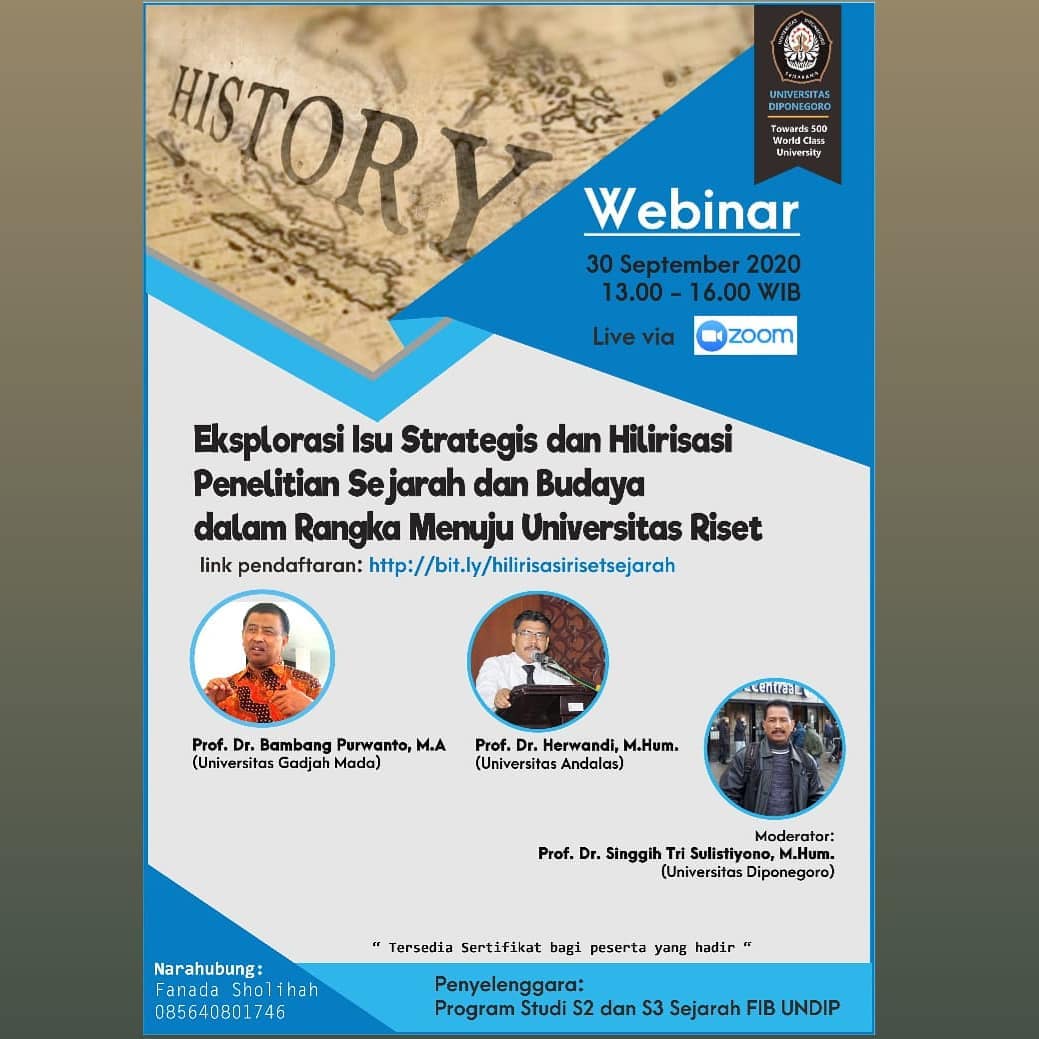
Semarang – History Science Program – Carrying a futuristic theme, “Exploration of Strategic Issues and Downstreaming of Historical and Cultural Research in Marching as a Research University”, Masters and Doctoral Programs in History, Faculty of Humanities, Diponegoro University held a National Webinar. This event presented two speakers who are competent in their fields, namely Prof. Dr. Bambang Purwanto, M.A. (Gadjah Mada University) and Prof. Dr. Herwandi, M. Hum. (Andalas University). This event hold on September 30th, 2020 via an online platform.
This webinar was opened by the Dean of the Faculty of Humanities, Dr. Nurhayati, M. Hum. “This topic is relevant to the needs of universities in the current era. One of the demands of the government in the industrial era 4.0. Universities should synergize both with other universities at home and abroad, as well as with institutions, and the community for cooperating during the industrial revolution era,” explained Dr. Nurhayati, M. Hum., in her speech.

Dr. Nurhayati also sees that history science is dynamic so that it is able to be at the forefront of facing the 4.0 Revolution.
This seminar was moderated by Prof. Dr. Singgih Tri Sulistiyono, M. Hum. (Professor of History at Diponegoro University). Prof. Singgih opened the discussion with an interesting understanding of the new phenomena experienced by sciences, including history in the Information Disruption Era.
There is a reversal of values that have been considered established so far, namely the entry of a very thick economic content, which leads to the commercialization of science. At first the expansion was felt in the fields of nature sciences and technology -which indeed have very practical roles and functions to increase prosperity and improve the people’s economy-.
“However, right now we are starting to feel a rather strange situation. That cultural sciences, including history will be drawn into a space that was previously sacred towards commercialization. The policy of the Ministry of Research, Technology and Higher Education has also begun to target this.” explained the Professor who had been a keynote speaker in Brussels.
Prof. Herwandi, the first speaker in this event, explained how the position of social sciences and humanities is often marginalized. In the development of scientific history, starting in the 18th century. There is an assumption that the truest science is nature science since it can produce models that can be used to solve problems of the general public and strengthen state power. “The history of science places the exact sciences as prima donna, which is in direct contact with community problems. So the country needs nature sciences, such as shipping, marine, astrology, medicine, and economics,” he explained.
Indeed, there is a thought that develops among humanities academics, if you want to say it is a useful science, you must use a methodology like a natural science. Therefore, in the context of historical downstreaming, Prof. Herwandi gave the view that history should not be limited to research papers, historical writings, books, journals, theses, but also documentaries, historical or cultural films, historical or cultural theater, replicas, sculpture, batik and weaving, screen printing and relief art, dioramas, and others.
In the current era of information and technology, it is very important for history science to adapt and provide ample space for the creative process.
Furthermore, Prof. Dr. Bambang Purwanto, M.A., revealed several agendas that can be followed up on strategic issues in history, for example the history of healthy food, the history of daily life of a healthy lifestyle, the history of collective mentality from irrational actions when dealing with epidemics, cultural history related to disease, history of drugs and their consumption, and others.
“The existence of adequate understanding and knowledge of the past time will provide space for history as a science to make contributions that can be used as reference material in policy,” he explained.
Important notes that can be taken from the presentation of Prof. Bambang, of course, history does not have the prerogative to determine when Covid will end, but history is able to show concern for the present and a sustainable future. So historians must have a concern for the future.

Prof. Singgih concluded that historical studies should not continue to be in the ivory tower, but must be down to earth, so that it can benefit the community. This seminar is our concrete effort to review the relevance of history in solving contemporary problems, which are closely related to economic interests.
