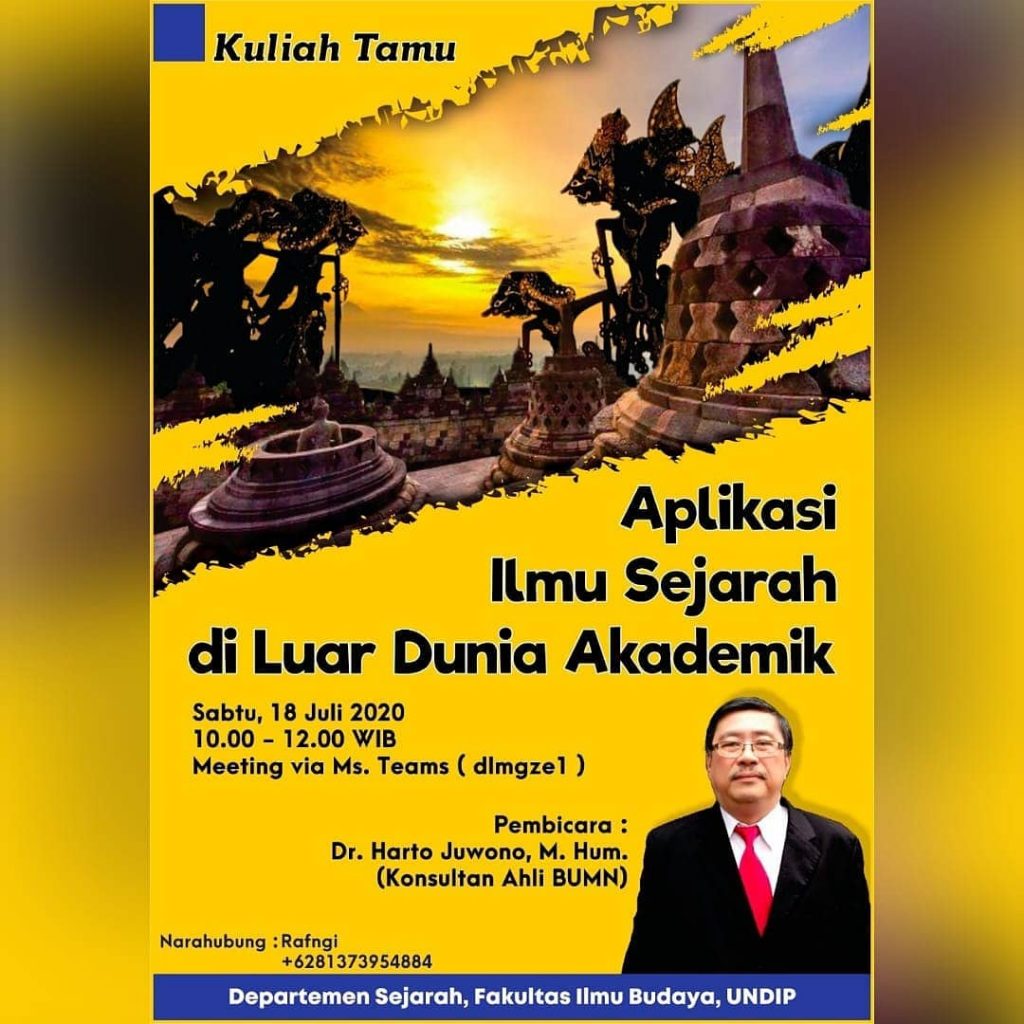
Department of History Science Undip – The public lecture with the theme “Application of History Science Beyond the Academic World” was opened with a reflective statement by the Head of the Department of History, Faculty of Humanities, Diponegoro University, Dr. Dhanang Respati Puguh, M. Hum. By this time, history science students have had doubts and indecision about the future. This is often articulated with a bitter tone of question, which even comes from the students themselves, “After graduating, what do I want to do?”
Public Lecture with Dr. Harto Juwono, M.Hum., a BUMN consultant, aims to deconstruct understanding about it. This lecture was held through the Ms. Teams on Saturday (18/07/2020). Students from various universities in Indonesia are actively participating in this course, including from the University of Indonesia (UI), Gadjah Mada University (UGM), Defense University, the State Islamic Institute (UIN) Kediri, and others.
Dr. Harto Juwono opened the discussion with a series of critical questions, “Is it true that history is useless for public problems? So, what do society need? do people just want to hear stories and facts about the past? or want further benefits?” The answer is of course clear, history will be valuable if it is displayed not as a chronicle or facts of the past, but also as a provision to solve contemporary problems (problem solving). If the existence of historians only functions as a narrator of the past, without being a solver of contemporary problems, then the position of historians in the eyes of the public is not yet capable of broader responsibilities.
Historians have a more open space to contribute. Dr. Harto Yuwono, M. Hum., is a concrete example of how graduates of the History Science Program can utilize historical knowledge to solve contemporary problems. Even though he is involved in the world outside of history as a consultant for State Own Enterprise (SOEs), he is able to optimally utilize the historical knowledge gained from college. One of the pieces of knowledge that has a significant contribution in his career path is Dutch. His dexterity in reading ancient manuscripts in artistic Paleographic letters also often gave him the opportunity as an expert witness in various agrarian disputes, for example related to land ownership status. In this position, historians play an important role in critiquing historical documents presented at the trial table. This is to avoid attempts to falsify documents from interested parties. “What is being judged is not humans, but data. Historians are also asked to present credible data regarding the cases being tried. Historians have the authority to criticize the archives presented,” he concluded.
On this occasion, Dr. Harto Juwono also told the participants, the majority of whom were history science students, to broaden their perspective on future careers. If understanding carefully, historians have the power to present credible historical documents. Therefore, many historians are currently highly ‘hunted’ by the film industry as data providers, data analyzers, and others.