
Written by: Fanada Sholihah
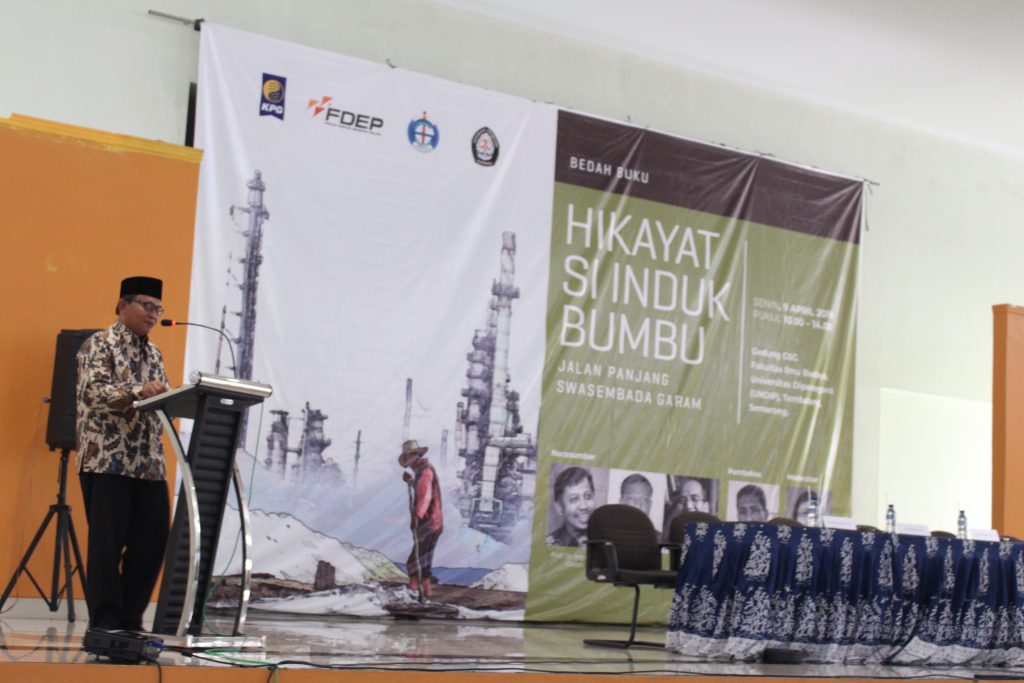
Located in the Multipurpose Building of the Faculty of Humanities, Undip, the book review “The Tale of Spices: The Long Road to Salt Self-sufficiency” was held by the Doctoral Program in History of the Faculty of Humanities, Diponegoro University in collaboration with the Popular Literature Publisher Gramedia (KPG), the Political Economy Discussion Forum (FDEP) and the Association of Indonesian Salt Experts (HAGI) took place in person on Monday (9/4/18). Also present were various groups from the Undip academic community, the Head of the Maritime Affairs and Fisheries Service from various cities, including Semarang, Rembang, Demak, Jepara and Brebes and the Head of the Industry and Trade Office of Central Java Province and the city of Semarang, the book review event was lively. Together with the speakers, namely Prof. Dr. Ing. Misri Gozan (UI), Dr. Makhfud Efendy (UTM), Faisal Basri, M. A (UI), Prof. Dr. Singgih Tri S., M. Hum (FIB Undip) as the discussant, Prof. Dr. Yety, Rochwulaningsih, M. Si as moderators of the discussion went very smoothly.
Departing from the title of the book, we soon realize that the use of the term Hikayat is not just “sticking” without having a message. We will easily find the term “Hikayat” in historical treatises, which are full of magical and sacred elements.
The term “Hikayat” seems to be deliberately presented to invite readers to think historically for a moment, that there are local geniuses from the past who also enrich today’s cultural treasures.
At least, the cultural treasures are documented in the Biluluk Inscription from Majahapit which is estimated to have been carved in the XIV century, in which it alludes to salt production in the area that is now on the north coast of Central Java and East Java. At that time, salt was made by flowing sea water into drying fields on the coast and evaporated by sunlight.
Meanwhile, the term “Si Induk Bamboo” refers to Salt, which is the mother of all spices. No matter how complete the seasoning is, without adding salt, the dish at the dinner table will still be considered bland.
The unification of the two terms seems to want to bring up the issue of salt as a study that is as important as other saga, which continues to be told and analyzed like the Hikayat Hang Tuah or Hikayat Raja Ali Haji.
Prof. Dr. Singgih Tri Difficultiyono, professor of History, Faculty of Cultural Sciences, Undip, who that afternoon had the opportunity to be a book reviewer to examine the contents of this book, there are at least 3 things that become the main focus: First, why efforts to become self-sufficient in salt have not been achieved. Second, what are the challenges faced. Third, what steps can be taken to achieve salt self-sufficiency.
This book is interesting because it not only provides definitive information about consumption and industrial salt, but also how and why salt is an important economic commodity. This can be seen from the actions of salt in building and bringing down cities. Before the Cheshire salt mines were discovered, Liverpool was just a small port. At the end of the seventeenth century, the Cheshire quarry was discovered and it soon became one of the sources of English salt. The port of Liverpool is the most strategic place to ship salt to various countries. In addition to Liverpool, Munich and many other cities managed to grow and develop because they are supported by affinity with salt, such as Timbuktu in Mali and Africa. Even during the heyday of Rome through the Middle Ages, Timbuktu was an important salt trading hub for Europe and Africa.
Salt also invites rebellion and war. In the middle of the XVI century, the inhabitants of Perugia revolted and became involved in a war with the Holy See over salt. This war ended in Perugia’s defeat and brought the city completely under the rule of the Holy See (p. 26).
In his presentation, Prof. Ing Misri Gozan from the University of Indonesia also emphasized that even though salt seems so trivial as a home consumption item, the calculation of salt needs is only 10 grams per person per day, which means multiplied by 365 days in a year, a total of 3.7 kg. If it is nominalized, one year, each person only spends Rp. 7.500,- to buy salt. It does seem very trivial.
However, the frame of mind that must be used in positioning salt has to be changed. Salt must be seen from the industry’s interest that plays the size of tons not grams. In industrial processes, the glass industry needs soda ash -a chemical product made from salt as raw material. Drilling platforms also need salt in the process of digging oil and gas wells. Finally, at the industrial level, it is actually the key to Indonesia’s salt self-sufficiency.