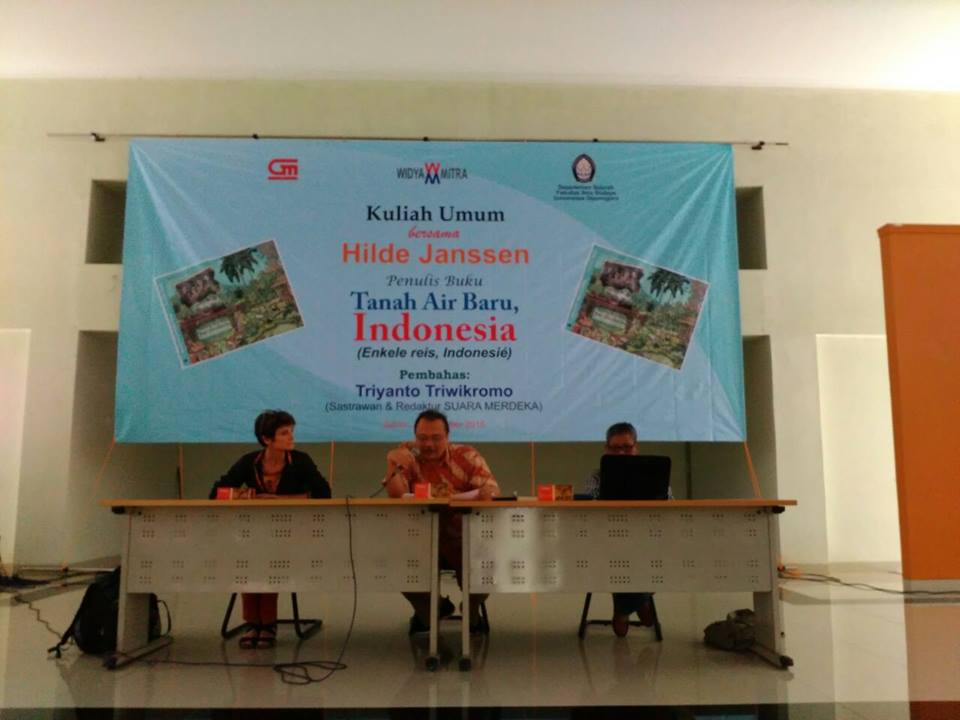
Semarang- 7 November 2016, taking place at the Multipurpose Building of the Faculty of Cultural Sciences, Diponegoro University (Undip), the public lecture with Hilde Janssen, author of a book entitled “The New Homeland of Indonesia (Enkele Reis, Indonesia)” was lively. More than one hundred Undip students were present. This event is a collaboration between the Department of History, Diponegoro University and Gramedia Publishers and Widya Mitra. The book with a historical background of 336 pages was dissected by Triyanto Triwikromo, a writer and editor of Suara Merdeka. This book was born from Hilde’s interest in a photo she found while attending an exhibition commemorating the 65th anniversary of the Republic of Indonesia. The photo reads: “Miny (holding a ukulele) and Annie on a train journey from the port of Jakarta to Yogyakarta, at the Kranji border, January 1947. Between them stands Annie’s husband, Djabir, in front of them a Dutch military (photo archive Antara Jakarta, IPPHOS photo).” He finally questioned why the women actually went to Java, which was hostile to the Dutch. In fact, the political situation in Indonesia is in turmoil. Moreover, their white skin can easily be negatively associated with the natives who at that time were struggling to defend Indonesia’s independence.
Based on the search she did, Hilde finally got information that the four women posing in the photo were Annie Kobus and her two sisters, Betsy and Miny, and Dolly. They were about 20 years old when they left Amsterdam at the end of 1946 with their Indonesian husbands. They did not feel a serious sense of fear when they returned to Indonesia, instead choosing to travel around Java. The decision they made to go to Indonesia was based on their determination that they were Indonesian citizens because they were married to Indonesians/ “I support the Republic.” For her and other women who arrived in Indonesia, they stated emphatically that choosing an Indonesian husband meant choosing a new homeland, namely Indonesia (see page 19). The women from the Netherlands were finally involved in the struggle for Indonesian independence, and even committed to support Indonesia in the following years. The author is also a Dutch, he is able to understand the psychological conditions of the four women he wrote quite well.