
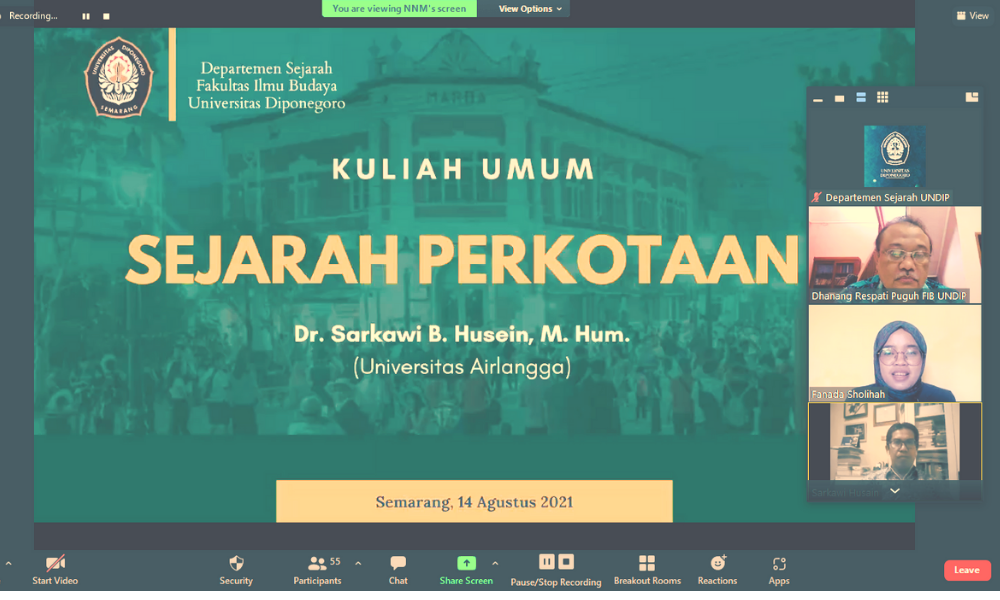
The Department of History, Faculty of Humanities, Universitas Diponegoro organized a Public Lecture on Urban History (14/8) with Dr. Sarkawi B. Husain, M. Hum. (Universitas Airlangga) and moderated by Dr. Indriyanto, M. Hum. (Lecturer of History Department). The Dean of Faculty of Humanities, Undip, Dr. Nurhayati, M. Hum., expressed her appreciation for the consistency of the History Department in organizing webinars with the diverse themes.
In his material, Dr. Sarkawi conveyed about the importance of urban history in historical studies as well as areas of urban history study, which include the development of urban ecology, socio-economic transformation, social problems, social mobility, and city symbols. History occupies such a strategic position because history is “the mother” of social science. The history of the city is significant because since the twentieth century, the cities in Indonesia have taken over many activities from the countryside, for instances, the resistance to colonialism, which no longer in the village with rural leaders as the driving force, but in the city with the educated and middle class. Therefore, the city has its own entity and could be a separate field of study.

“The field of urban history studies, including the development of urban ecology. Ecology is the interaction between humans and their natural surroundings and ecological changes occur when one of the components experiences changes. The use of urban land for various purposes has changed the natural state of the land into various sectors. There is land for residential, trade, industry, recreation, offices and others,” he said. “Ecological changes also occur according to population development, ethnically, socio-economic status, culturally so that settlement patterns experience grouping. In many colonial cities, such as Surabaya, this settlement pattern was designed by the colonial government. In a modern city, the pattern of settlement distribution is mostly based on social class, the old city dwellers are displaced or evicted by new residents who occupy strategic locations,” he continued.
While other studies on city symbols include other than statues and monuments, there are many other interesting and important aspects such as street names, city symbols, religious symbols and Islamic tombs, and Chinese tombs. The study of city symbols is fascinating and important to do with three considerations. First, most symbols use physical space, for instance monuments. Second, symbols affect other uses of space, and vice versa also influenced by other uses of space. Third, the dynamics of city symbols reflect changes in the power structure.

“According to Els Bogaerts, History is a long journey, we must not look for shortest way in achieving the goals immediately,” concluded Dr. Sarkawi.
The press release has been published at https://www.undip.ac.id/post/20615/departemen-sejarah-fib-undip-gelar-kuliah-umum-sejarah-perkotaan.html