
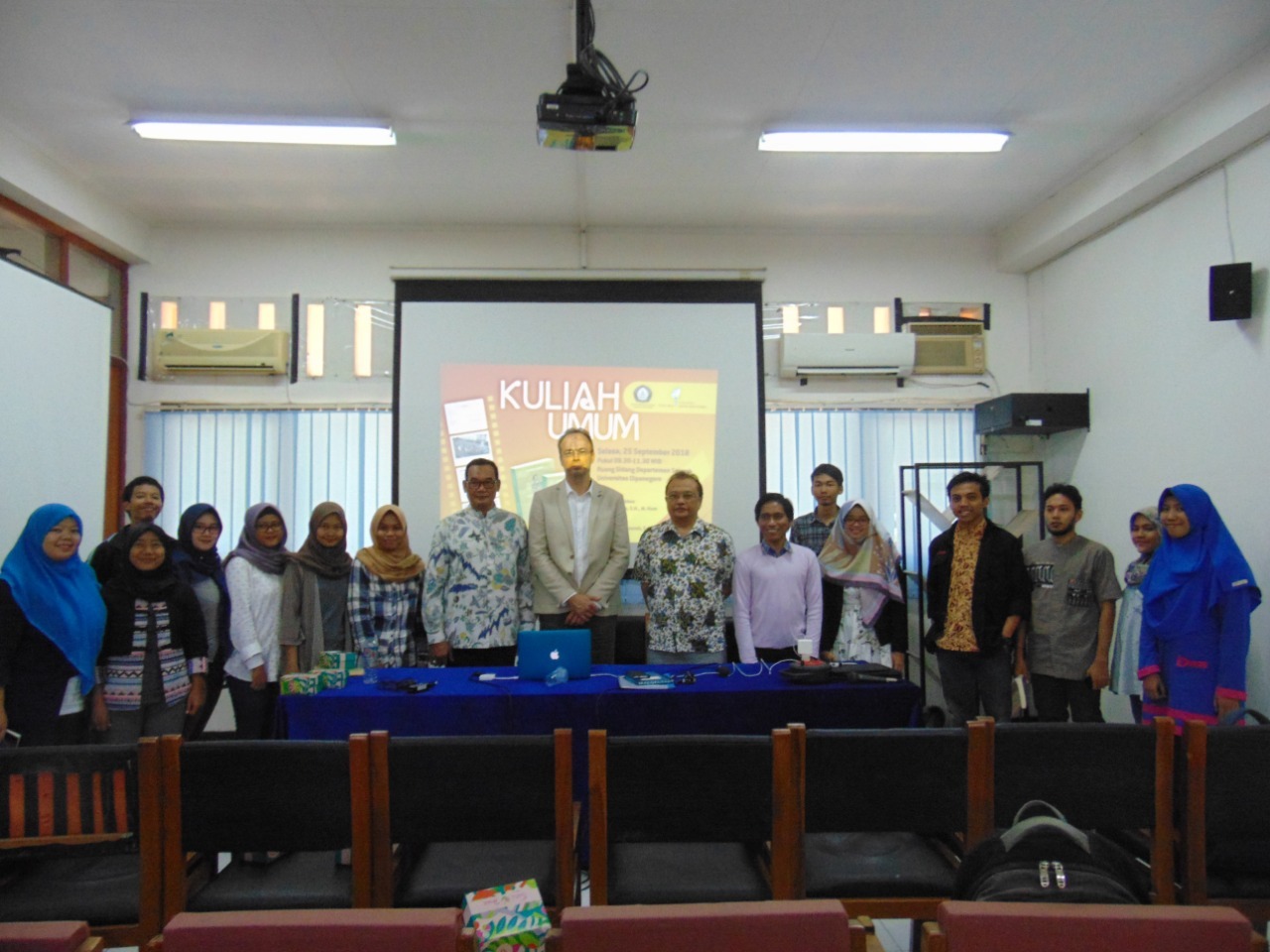

Di Belanda, Tak Seorang Pun Mempercayai Saya adalah buah dari riset panjang Maarten Hidskes, anak kandung dari Piet Hidskes, seorang tentara spesial Belanda yang bertugas di bawah komando Westerling pada 1946-1947 di Sulawesi Selatan.
Departemen Sejarah, Fakultas Ilmu Budaya, Universitas Diponegoro pada Rabu (25/09/2018) menyambut kehadiran Maarten. Riuh tepuk tangan mahasiswa dari Departemen Sejarah semakin melengkapi suasana akademis di dalam ruangan. Buku ini dibedah oleh pakar sejarah militer, Dr. Indiyanto, M.Hum., dari Departemen Sejarah Undip.
Wakil Dekan bidang Akademik dan Mahasiwa, Profesor Dr. Singgih Tri Sulistiyono membuka dengan nada yang penuh simpatik atas selesainya buku yang diproses hampir seperempat abad itu, kuliah ini juga penting karena dalam historiografi Indonesia, topik Westerling melulu dihubungkan dengan pembantaian massal yang mengorbankan sekitar 40.000 jiwa. “Today’s lecturer we will hear about the detail event. One of the most curcial event in the revolution era in Indonesia. Mr. Marteen did research very detail, because it is about his father. The Dutch perspective on the Westerling case, the Dutch government sent 150.000 soldiers to Indonesia in five years. One of the soldier is Piet Hidskes. Maarten Hidskes clearly underline that the story about his father was potray mainly on Dutch perspective, using eye witness statement, Dutch political journal, intelligence archives.” Setidaknya, dalam kesempatan ini, peristiwa Sulawesi Selatan pada tahun 1946-1947 akan dipotret dari perspektif Belanda.
Sebagaimana yang diungkap oleh Maarteen, “I went to National Archives, Military Institute. I did very limited resource on Indonesian sources, I do have specific Indonesian sources, but this was all translated by the Dutch civil servants in 1946-1947.” Sejarah yang disampaikan oleh Maarten hanyalah mewakili satu sudut pandang (one-side history). Sekalipun demikian, Maarten tidak menuntut para pembaca untuk mengamini apa yang diargumentsikan dalam tulisannya, karena apa yang dianggap sebagai “kebenaran” sangat bergantung sudut pandang, lanjutnya “I do not pretend to tell you anything like the truth, the only thing I would talk about is my personal interpretation of what my father might have been done. Futhermore, as you know in Nederland, there is a really big national project on researching colonial violence, although I have already put contact with many people inside this project, including exchange the data. I am an independent researcher and I am represent only my self and my father.”
Transkripsi presentasi Maarten ini setidaknya mampu menjelaskan pentingnya buku ini:
[My father and me had a vacation in France in 1980, my father love to “mandying (mandi)” himself, every vacation he always did that and he says that this is a typically Indonesian habit. My father was a kind man, was a family man, full of love. It is obviously no secret that my father has been a soldier that he went voluntary to Indonesia. I knew when I was a boy about 7 years old. My father had been a special soldier, and I once asked him, I put the question toward him, “Daddy, did you ever kill a man?” the my father laid his hand on my head, I can feel his hand, it was very warm, and he said, “we will talk about it later, son”
And I immediately felt the enormous of energy, the tension of the statement, “we will talk about it later, son”. The problem is, we never talk about Indonesia. In 1992, he died, he only left some photos, identification with the name side of Westerling, and when I was 25 in 1992, I did not know that Westerling had something to do with special action. And after the funeral, I did realize that I knew nothing about my father. And I start to talking with nine former man of the Westerling troops and nine man of the Sulawesi troops.
I got the information on my first conversations. “I never ever told my wife what it was really like”, “These 12 weeks on Sulawesi were formative for the rest of my life”, “If I will tell them in Holland, no one will believe me”, “It should have never happened.”, “Half a bullet for the enemy does not exist” I put main research questions: what did my father do during the 12 weeks of the Sulawesi military Campaign?
Why did he never talk about it? That was the conversation in Nederland society about 15 years, every body talk about this man, but no body has a conversation with this man.
I use Dutch sources, the main sources that I used is oral history, eye witness statement, people who stand beside my father during the execution, people who went to Sulawesi to do military Campaign, Big expectation, limited mandate. Mostly, the soldiers ca not imagine how big Indonesia is. We are a very small country. And the Dutch army is going to re-establish peace and order in Indonesia.
My father volunteered in Depot Speciale Troepen (Depot Pasukan Khusus), he is one of the first man to enter the Westerling troops and Westerling troops was very small, consists of 123 men of which 20-30 was Belandas (NL, Scotland, Ceylon), the rest was former KNIL, commander: 1st lt. Westerling, 24 years old, seconded by Jan Baptist Vermeulen.
The training was six month, from June to December 1946. The training was focusing on one element, and the element was crossing any border you have, putting your own limit. They had to jump from 12 meter without any security. December 1946, DST felt ready. According to the Dutch sources, the security situation in Sulawesi in late 1946 was terrible, hundreds of people had been murdered or kidnap massacre. Big problem for the Dutch was the intelligence in Sulawesi was extremely limited. Wasterling was ruled to clean up the mass in Sulawesi Selatan, “you can do in a way whatever you want, the method is yours to decide”. So, Westerling is completely free to choose the method.
For Piet, after five, ten, twenty executions, all kind of question raised in his head;
At the first evening after the first action, they discussed very fiercely what did they exactly did. And the more important question, is there any important necessity executing this mount of people. When I (Maarteen) heard about this fact, I was really angry to my father for many years who has been died, because I raised a question, what would happened if one of soldier refused to execute the actions, they told me that it was absolutely not a problem at all or will be punished. It is not an obligation to stay. I was angry with my father, and it was important to not excuse my father and not defend it. I want to know which kind of expectation of Westerling Campaign in Sulawesi and why did he quit?
What insight does the book offer?
My father was some kind voluntary admission, was executing people, he was alienated from himself, he was fighting ideas his head on military necessity on one hand and quiting his job on the other hand. My father really did not understand what was going on in Indonesia by the time.
The conflict, Sulawesi military campaign did not solve any problem in Sulawesi, only loss and sorrow. My father got frustrated and later on completely loss his confidence in Dutch authorities and Dutch military system. The violence in Sulawesi is a kind of representation of the fact that the Dutch had limited concept of what’s going on, limited intelligence of the conflict.
I discover that my father did not worse, did not better than any other soldier and any other colonial conflict. I describe my father for a long time in terms like he joined the troops, he was the witness of the executions, the was the wrong guy, at the wrong moment and the wrong place in the same time. I describe in a very not active verb or word. But, when executions or violence happen, someone has to create this violence, my father conduct the executions, he was not the witness in this situations, he was not involves in. He was making this situation, an active part of situation. If you want to discover personal stories, you need to keep in open-mind to what happen. I do not judge my father nor defend him, I do not want to attack him, I love my father, but I have a lot of criticism on the way act on Sulawesi Selatan. And I want to keep open mind, first I get the fact that I made some kind of analysis, perhaps for you to realize as future history teacher to give yourself space to postpone your judgment. If you postpone your judgement you can get into the discussion of other people. And you can get the real insight into history].
Saat membedah buku ini, Dr. Indriyanto membukanya dengan kata pujian. “Buku ini sangat menarik, ditulis dengan gaya bahasa yang menggungah selayaknya roman sejarah, lebih menarik lagi, buku ini kaya akan sumber”. Roman sejarah sebagaimana tulisan-tulisan Pramoedya Ananta Toer dapat membawa pembaca seakan-akan hidup pada zaman itu, bahkan tidak jarang pembaca seringkali mengidentifikasikan dirinya ke dalam salah satu karakter dalam cerita. Biasanya, roman penuh dengan pertanyaan-pertanyaan dan tanya-jawab, dan pembaca dapat merasai suasana yang diungkap oleh penulis. Jadi, buku ini adalah roman sejarah yang kaya akan fakta sejarah. Hanya sumber-sumber yang digunakan didalam buku ini semuanya berbahasa Belanda, Maarteen tidak melakukan wawancara dengan orang-orang Indonesia. Sehingga jelas bahwa buku ini menggunakan perspektif Belanda, terutama terutama perspektif “saya” sebagai anak.
Tapi, buku ini selangkah lebih maju karena telah mengisi kekosangan atas sebuah kontruksi peristiwa yang saat ini masih banyak yang harus ditulis ulang dari sisi perspektif yang berbeda. Maarten gelisah, ingin bertanya tentang berbagai macam cerita-cerita yang kontroversi yang terjadi di Sulawesi Selatan, pada satu sisi ini adalah penjahat perang, sebuah pembataian, tapi di sisi lain laporan Belanda pada tahun 1947 menganggap pasukan Westerling sebagai pahlawan. Mereka adalah pahlawan-pahlawan yang membersihkan dan mengamankan wilayah Hindia-Belanda yang akan diduduki kembali. Buku ini memang ditulis lebih kepada sebuah ketidakpercayaan akan peran yang dilakukan oleh Piet, “apakah benar bapak saya sekejam itu?”, “apakah benar bapak saya seperti yang diberitakan?”. Akhirnya, Maarten berusaha mencari kebenarannya, banyak anak-anak Belanda yang merupakan anak cucu dari tentara-tentara Belanda mulai menulis kembali sejarah orang tuanya ketika berada di Indonesia. Ribuan pasukan Belanda didatangkan ke Indonesia tetapi sia-sia. Tetapi apa yang mereka dapatkan? Indonesia tetap saja merdeka.
Apa yang terjadi di Sulawesi Selatan yang dilakukan oleh Westerling sesungguhnya banyak dilakukan di peperangan-peperangan yang lain, di Vietnam, Jerman, Bosnia, banyak pembunuhan dan pembantaian yang berlangsung. Sementara itu, yang perlu didudukkan adalah, apakah itu sebuah “kejahatan” atau “justifikasi” kebenaran? Jika sudut pandangnya berbeda maka yang menengahi adalah konvensi Internasional. Dalam Konvensi Internasional, bahwa perang boleh saling membunuh apabila pasukan musuh menyerang, tetapi apabila musuh itu sudah tidak berdaya sama sekali, lemah, menyerah, dan ada anak-anak, orangtua dan perempuan. Semua itu telah diatur dalam konvensi, jika ada operasi militer kemudian terjadi pembunuhan atas hal-hal yang diatur oleh konvensi internasional tentang perang, maka di situlah terjadi kejahatan atau kriminal perang sehingga diatur oleh hukum pidana militer, orang-orang yang melakukan pelanggaran terhadap konvensi, aturan dan norma-norma peperangan. Westerling ketika bertugas sebagai pasukan khusus yang ditugaskan dari Batavia karena ada laporan bahwa di Sulawesi Selatan terjadi kerusuhan yang luar biasa, banyak terjadi pemberontakan, dikhawatirkan situasi di sana semakin rusuh, tidak aman, dan tidak terkendali, maka dijawab oleh para petinggi di Jakarta, satu-satunya jalan adalah dikirimnya pasukan khusus ke Sulawesi Selatan.
Selanjutnya, Dr. Indriyanto mengimbau bahwa sebagai sejarawan tidak boleh memandang perspektif hanya black atau white, sesuatu pasti baik atau pasti buruk. Karena selalu ada sisi sisi pembenar mengapa mereka melakukan hal tersebut. Perspektif Belanda beranggapan bahwa wilayah-wilayah itu harus diamankan dari kerusuhan, karena pada waktu itu belum ada KMB, sehingga belanda beranggapan bahwa itu masih wilayahnya, jadi mesti diamankan, terutaman untuk wilayah Indonesia timur. Konteks mengamankan itu maka petinggi Belanda, para pemimpin militer Belanda yang berkuasa di Sulawesi Selatan memandang pejuang-pejuang sebagai “penjahat”. Mereka dikatakan sebagai perusuh atau pengacau. Seperti halnya dalam melihat P. Diponegoro, dia dianggap pemberontak dari Jawa, tetapi dianggap sebagai pahlawan oleh orang Indonesia.
Maarten banyak melakukan pembelaan terhadap ayahnya, pembelaan dalam arti interpretasi, yakni membayangkan tentang ayahnya ketika ada di sana tetapi menurut hati nuraninya Maarten. Sehingga Maarten mencoba melakukan interpretasi untuk membela ayahnya, hal itu dinggap wajar-wajar saja, karena di dalam mindset Maarten bahwa ayahnya baik. Interpretasi didasarkan pada sebuah banyakan atau imaginasi untuk menilai ayahnya dengan menggunakan kata-kata “seandainya pada waktu itu”.
Lebih jauh, kita bisa melihat bahwa jalan riset yang ditempuh oleh Maarten dapat memantik tampilnya perspektif Indonesia, sehingga pertukaran pandangan tentang peristiwa Sulawesi Selatan bisa dilakukan, supaya di masa mendatang terjadi kesepahaman bahwa perang adalah keputusan yang tidak baik. Buku ini sebenarnya jika ditulis dengan metode sejarah, dilengkapi footnote sangat layak menjadi penelitian disertasi. Buku ini membuka cakrawala bahwa ternyata peristiwa-peristiwa sejarah masih banyak yang belum diungkap (FS).
